
From 4 hours of daily admin to a fully automated intake pipeline
A 12-person accounting firm · 3 agents · 6 weeks
The situation
A 12-person accounting firm was growing — but their intake process wasn't keeping up. New client inquiries came in through three channels: a website contact form, direct email, and referrals who called the front desk. Each inquiry landed differently, got handled differently, and moved through onboarding at a different pace depending on who picked it up and when.
The firm's office manager was spending 3–4 hours daily on intake-related work: reading and sorting inquiries, sending initial response emails, chasing prospects who hadn't completed their onboarding paperwork, following up on unsigned engagement letters, and manually entering client data into their practice management system.
Nothing was broken. But nothing was scaling either. Every new client added to the administrative load linearly. The firm had turned down two referrals in Q3 because the team simply didn't have capacity to onboard them properly alongside an active tax season.
The core problem wasn't the work itself — it was that humans were doing work that didn't require human judgment.
What we built
We scoped three connected agents across a two-week build. Each agent handled a distinct stage of the intake and onboarding workflow.
Agent 1: Intake triage agent
Handles: all inbound inquiries across all channels
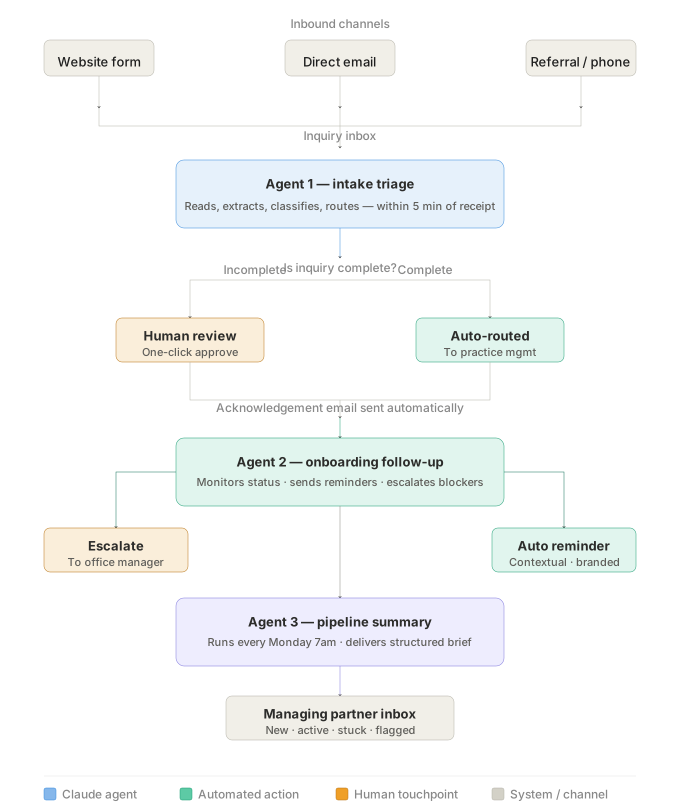
The intake agent monitors the firm's dedicated inquiry inbox continuously. When a new message arrives — whether a contact form submission forwarded by email, a direct inquiry, or a referral introduction — the agent reads it, extracts the relevant information, and produces a structured intake record:
- Prospect name and contact details
- Service type requested (tax prep, bookkeeping, advisory, other)
- Urgency signals (deadline mentioned, referral source, previous client)
- Completeness flag — is enough information present to move forward, or is follow-up needed?
- Recommended next action
If the inquiry is complete, the agent creates a record in the firm's practice management system and sends a personalized acknowledgment email within 5 minutes of receipt — at any hour, any day. If incomplete, it drafts a follow-up request for the specific missing information and routes it for one-click approval before sending.
The office manager's inbox went from a daily sorting task to a daily exceptions review. 90% of inquiries were handled without her involvement.
Agent 2: Onboarding follow-up agent
Handles: incomplete onboarding sequences
The onboarding agent monitors the status of all active prospect records. When a prospect hasn't completed their intake questionnaire within 48 hours, the agent sends a personalized follow-up. When an engagement letter hasn't been signed within 72 hours, it sends a reminder with a direct link. When a payment hasn't been received within the agreed window, it escalates to the office manager with a summary of the relationship status and recommended action.
Every follow-up is written in the firm's voice — referencing the specific service discussed, the specific document outstanding, and the specific next step. Not a generic reminder. A contextual, professional nudge that feels like it came from a person who knows the situation.
Before deployment, the average time from inquiry to completed onboarding was 11 days. After deployment: 4 days.
Agent 3: Weekly pipeline summary agent
Handles: visibility for the managing partner
Every Monday morning at 7am, the managing partner receives a structured pipeline summary:
- New inquiries received last week — count, source breakdown, service type
- Prospects currently in onboarding — status, days in pipeline, any stuck items
- Engagements completed and activated last week
- Follow-ups sent automatically vs. escalated to the team
- Flagged items requiring partner attention
What previously required the office manager to spend 45 minutes assembling from three systems now arrives as a clean, actionable brief before the week begins.
What the build looked like
Week 1 — Scope and connect. We mapped the firm's existing intake workflow — all three inbound channels, the practice management system, the engagement letter tool, and the email environment. We defined exactly what each agent would do, what it would escalate, and what the human review touchpoints would be. The office manager signed off on the escalation logic before any configuration began.
Weeks 2–3 — Build and test. Each agent was built and tested against 30 real historical inquiries and onboarding sequences from the previous quarter. We ran edge case scenarios — unusual service requests, incomplete inquiries, referrals who were previous clients — and refined the handling logic until the escalation rate was below 12%.
Handoff. A 90-minute walkthrough session with the office manager and managing partner. Full documentation delivered. A dedicated support channel for the 30-day post-launch window.
Ongoing. The firm is on the AI Operator retainer. Monthly performance review, prompt optimization, and configuration updates as the firm's service offering and onboarding process evolves.
This is a representative illustrative example based on a common workflow pattern we address. Specific results vary by firm size, existing systems, and workflow complexity.
| Daily admin time | 3–4 hours | 25–30 min |
| Inquiry response | 4–6 hrs (business hours) | < 5 min (24/7) |
| Time to onboarding | 11 days | 4 days |
| Unsigned after 7 days | ~30% | < 8% |
| Pipeline visibility | Weekly manual | Automated brief |
| Client capacity | Turned away 2 (Q3) | Onboarded 6 |
Agent architecture
How three connected AI agents handled the firm's intake end to end — triggers, connections, and human touchpoints.
This engagement started with a 90-minute AI Audit.
The managing partner had been thinking about AI automation for six months but couldn't identify where to start or justify the investment without a clear ROI picture. The Audit identified five workflow candidates. Intake triage ranked first on both ROI and implementation simplicity. The Quick Win Agent build followed two weeks later. The firm was on the AI Operator retainer within 60 days of the initial Audit.
Total time from first conversation to three running agents: 6 weeks.
Common questions
About this example and how it applies to your firm.
Start with a 90-minute AI Audit.
Find out where AI can run in your business — and what it's worth. Flat fee. Written report. No pressure.